
PMS vs Channel Manager: What's the Difference and Do Hotels Need Both?
By Foodle+ Team • • 11 MINS READ
If you're comparing PMS vs Channel Manager, here's the simple answer:
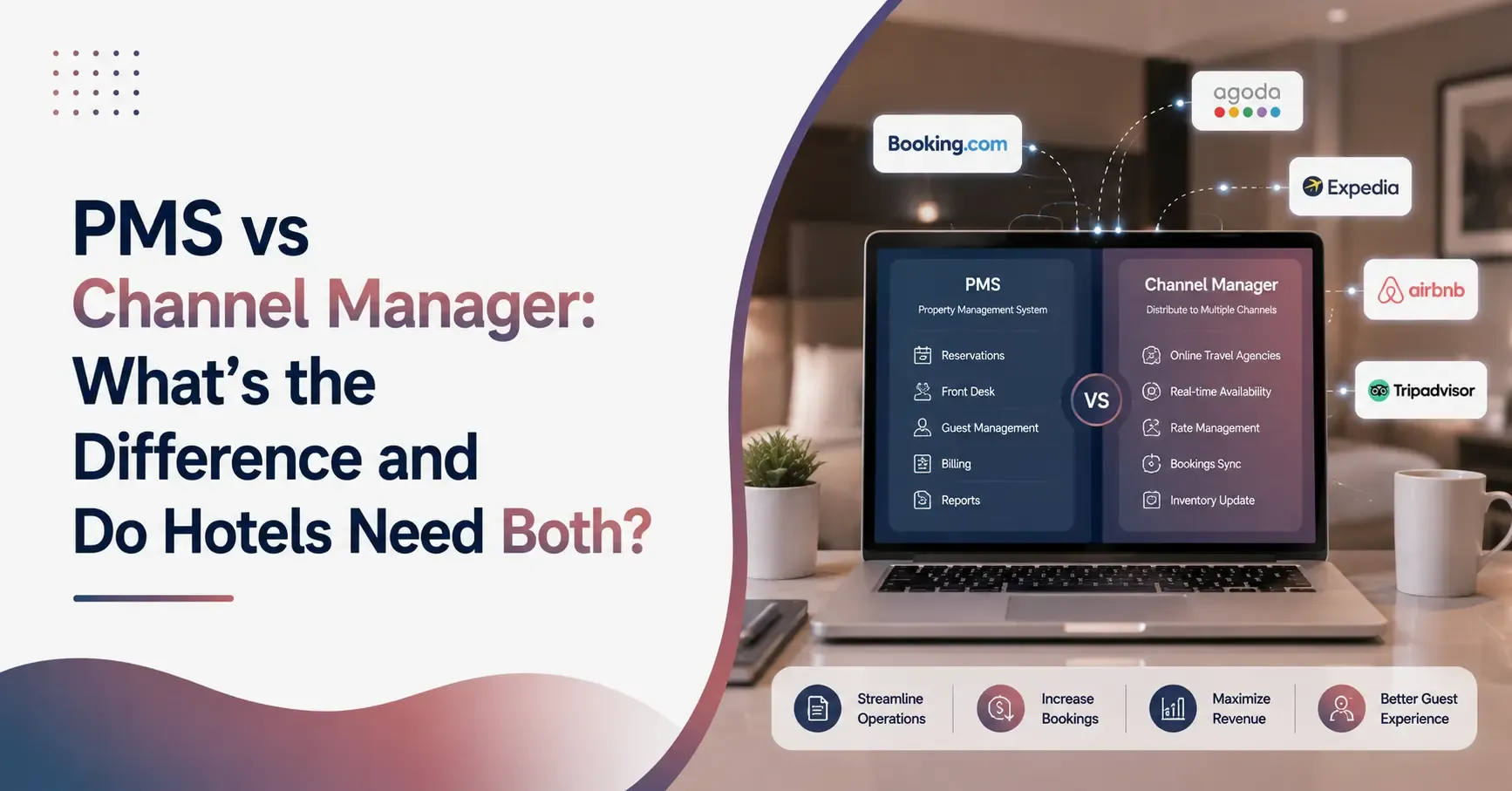
A Property Management System (PMS) helps hotels manage internal operations such as reservations, check-ins, housekeeping, billing, and guest information. A channel manager for hotels focuses on managing room inventory and rates across multiple online booking platforms like Booking .com , Expedia, Agoda, and MakeMyTrip.
In other words, a PMS runs your hotel, while a channel manager manages where and how your rooms are sold online.
The two systems serve different purposes, but together they create a connected hotel technology ecosystem that reduces manual work, prevents overbookings, and improves operational efficiency.
- PMS vs Channel Manager: Quick Comparison
- What Is a Property Management System (PMS)?
- What Is a Channel Manager?
- PMS and Channel Manager Difference
- How Do PMS and Channel Manager Work Together?
- Benefits of Integrating PMS and Channel Manager
- Which Hotels Should Use Both?
- Choosing the Right Hotel Software
- Final Thoughts
- Frequently Asked Questions
PMS vs Channel Manager: Quick Comparison
What Is a Property Management System (PMS)?

A Property Management System (PMS) is the central software that hotels use to manage day-to-day operations.
It acts as the operational backbone of a hotel by bringing multiple departments onto one platform.
A hotel PMS typically manages:
- Room reservations
- Guest check-in and check-out
- Housekeeping status
- Front desk operations
- Guest profiles
- Billing and invoicing
- Room availability
- Operational reports
Instead of relying on spreadsheets or manual registers, hotels can manage every stage of the guest journey through one system.
What Is a Channel Manager?
A channel manager for hotels is software that connects your hotel to multiple Online Travel Agencies (OTAs) and booking channels.
Rather than updating room availability manually across different platforms, the channel manager automatically synchronizes inventory, rates, and bookings in real time.
Common booking channels include:
- Booking.com
- Expedia
- Agoda
- Airbnb
- MakeMyTrip
- Goibibo
For example, if one room is booked on Booking.com, the channel manager instantly updates availability across every connected OTA, reducing the risk of double bookings.
Also Read: How to Connect Your Hotel to MakeMyTrip and Goibibo Through a Channel Manager
PMS and Channel Manager Difference
Although both systems deal with hotel bookings, they solve completely different problems.
The easiest way to understand the PMS and channel manager difference is this:
- A Property Management System (PMS) manages everything that happens inside your hotel after a booking is received.
- A Channel Manager manages everything that happens outside your hotel, ensuring your rooms are available across multiple online booking platforms.
Think of it this way:
A PMS is like the hotel's operations manager, while a channel manager is its online sales manager.
One helps your staff deliver a smooth guest experience, and the other helps you sell more rooms online.
Here's the Difference at a Glance
When Should You Choose a PMS?
A PMS is the right choice if your biggest challenge is managing daily hotel operations.
It's ideal when you need to:
- Track reservations in one place
- Speed up check-in and check-out
- Manage housekeeping efficiently
- Store guest information
- Generate invoices and reports
- Improve staff productivity
If most of your bookings already come through one source or you don't sell rooms across many OTAs, a PMS alone may cover your operational needs.
When Should You Choose a Channel Manager?
A channel manager for hotels is essential if your property is listed on multiple booking platforms.
You should prioritize a channel manager when you want to:
- Sell rooms on Booking.com, Expedia, Agoda, Airbnb, MakeMyTrip, Goibibo, and other OTAs
- Update prices across all booking websites instantly
- Keep room availability synchronized
- Avoid double bookings
- Save time by eliminating manual inventory updates
Without a channel manager, every booking requires manual updates across all connected OTAs, increasing the risk of errors.
Why Hotels Need Both Systems
Using only one of these systems creates operational gaps.
If You Only Use a PMS
You can manage hotel operations effectively, but you'll still need to manually update room inventory across every OTA.
This increases the risk of:
- Overbookings
- Pricing errors
- Delayed inventory updates
- Lost bookings
If You Only Use a Channel Manager
You can distribute inventory efficiently, but you'll still lack operational tools for:
- Check-in
- Housekeeping
- Guest management
- Billing
- Reports
Neither system replaces the other.
Together, they create a seamless workflow from booking to checkout.
How Do PMS and Channel Manager Work Together?
Modern hotels rarely use these systems independently.
Instead, the PMS and channel manager exchange information automatically.
Here's how the process works:
- A guest books a room through an OTA.
- The channel manager updates inventory across every connected platform.
- The booking is automatically sent to the PMS.
- The PMS prepares guest records, room allocation, and housekeeping tasks.
- Once the guest checks out, room availability is updated again and synchronized across all channels.
This automation eliminates duplicate work and significantly reduces human error.
Benefits of Integrating PMS and Channel Manager

Hotels that integrate both systems can achieve several operational benefits.
Reduce Overbookings
Real-time inventory synchronization ensures that rooms sold on one platform are immediately removed from all other booking channels.
Save Staff Time
Automation eliminates repetitive tasks like manually updating rates and availability across multiple OTAs.
Improve Revenue Management
Hotels can adjust pricing centrally and distribute updated rates instantly across all connected channels.
Enhance Guest Experience
Reservations flow directly into the PMS, enabling faster check-ins and better operational coordination.
Centralize Hotel Operations
Hotel teams can manage bookings, guest information, inventory, housekeeping, and distribution from an integrated technology stack instead of juggling multiple disconnected tools.
Also Read: How Can Hotels Reduce Front Desk Wait Times During Peak Check-In Hours?
Which Hotels Should Use Both?
Integrated PMS and channel manager software is valuable for:
- Hotels
- Resorts
- Boutique Hotels
- Homestays
- Vacation Rentals
- Serviced Apartments
- Hotel Chains
Properties listed on multiple OTAs benefit the most because inventory synchronization becomes increasingly difficult to manage manually as bookings grow.
Choosing the Right Hotel Software
When evaluating PMS vs Channel Manager software, look beyond basic features.
Consider whether the solution offers:
- Cloud-based access
- Real-time synchronization
- Open API integrations
- Multi-property management
- Mobile accessibility
- Reporting and analytics
- Revenue management compatibility
- Secure data storage
Choosing software that integrates well with the rest of your hotel technology stack can reduce operational complexity and support future growth.
Final Thoughts
The debate around PMS vs Channel Manager isn't about choosing one over the other.
A Property management system vs channel manager comparison shows that each serves a distinct purpose. The PMS manages internal hotel operations, while the channel manager ensures your room inventory and rates stay synchronized across online booking platforms.
As hotels increasingly rely on digital distribution and automation, integrating both systems has become the industry standard. Together, they improve efficiency, reduce manual work, minimize booking errors, and create a smoother experience for both hotel staff and guests.
FAQs
What is the difference between PMS and Channel Manager?
Do hotels need both a PMS and a Channel Manager?
Can a Channel Manager work without a PMS?
Does a PMS include a Channel Manager?
Which hotels benefit the most from a PMS and Channel Manager integration?
Related Posts
Hospitality
Why Hotels Lose Money Through Manual Operations (And How Hotel Operations Automation Solves It)
19 Aug 2026
Property Management System
Cloud PMS vs Traditional PMS: Which Is Better for Modern Hotels?
19 Aug 2026
Property Management System
Best Hotel PMS Software: How to Choose the Right System for Your Hotel
8 Sept 2026